Banggai cardinalfish (Pterapogon kauderni) are small striped reef fish found naturally only around the Banggai Islands off Central Sulawesi, Indonesia. The IUCN lists them as Endangered, and the best place to see them is the shallow water of Banggai Laut, where they hide among sea urchins and anemones a few metres from the beach.
We run trips to these islands from Luwuk, the mainland town across the strait. This guide covers where the fish live, how to reach them, what to look for underwater and how to watch without causing damage. Aquarium keepers will find a short section for them near the end.
Where are Banggai cardinalfish found?
The species’ natural home is the Banggai archipelago: Peleng, Banggai Laut and the small islands around them. A 2022 Mongabay Indonesia report put its entire range at about 5,500 km² of sea, which is tiny for a marine fish.
Most of the wild population lives in three regencies: Banggai (the mainland around Luwuk), Banggai Kepulauan (Peleng) and Banggai Laut. Groups have also turned up well outside that range, in Luwuk harbour and in the Lembeh Strait in North Sulawesi. Researchers trace these back to fish released or lost by the aquarium trade, so they live wild but are not native.
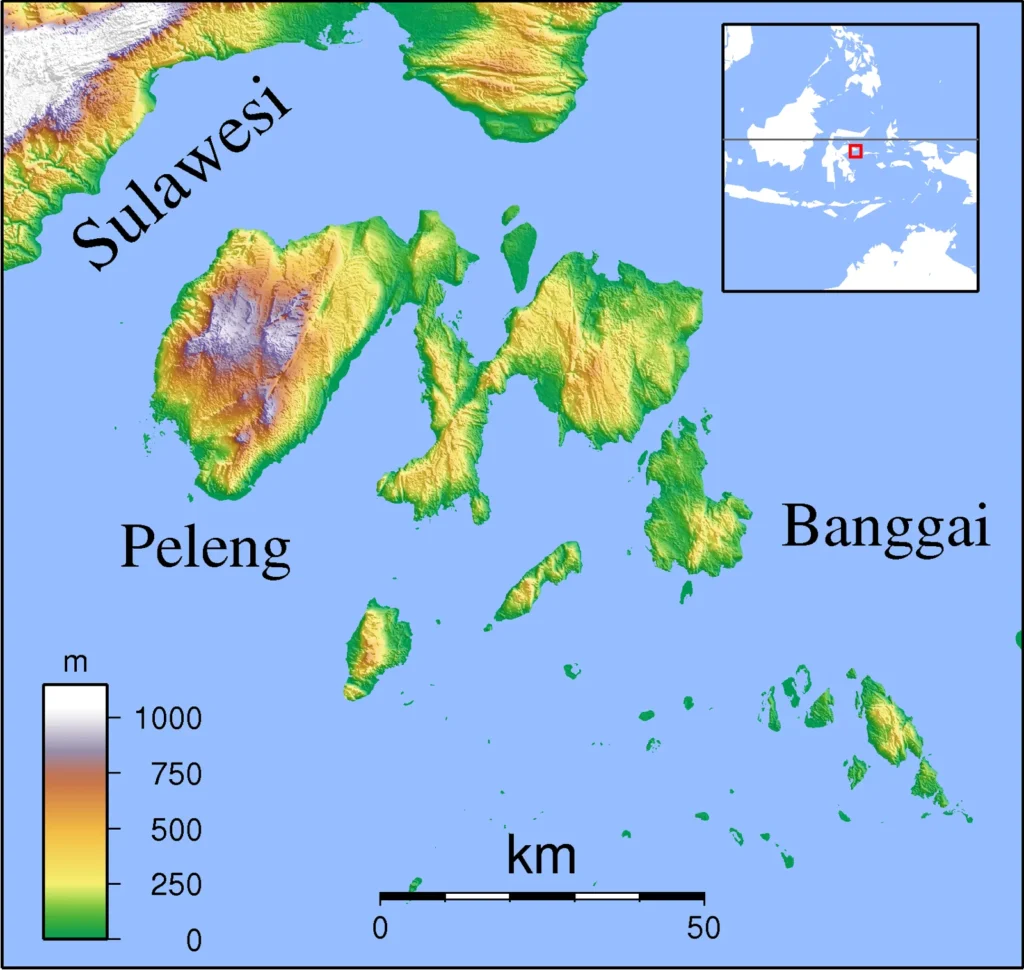
That difference matters if you are planning a trip around the fish. Spotting them in Lembeh is a nice bonus on a dive holiday. Seeing them in Banggai means seeing the species where it evolved, in the seagrass and reef shallows that are still its main stronghold.
How to recognise one underwater
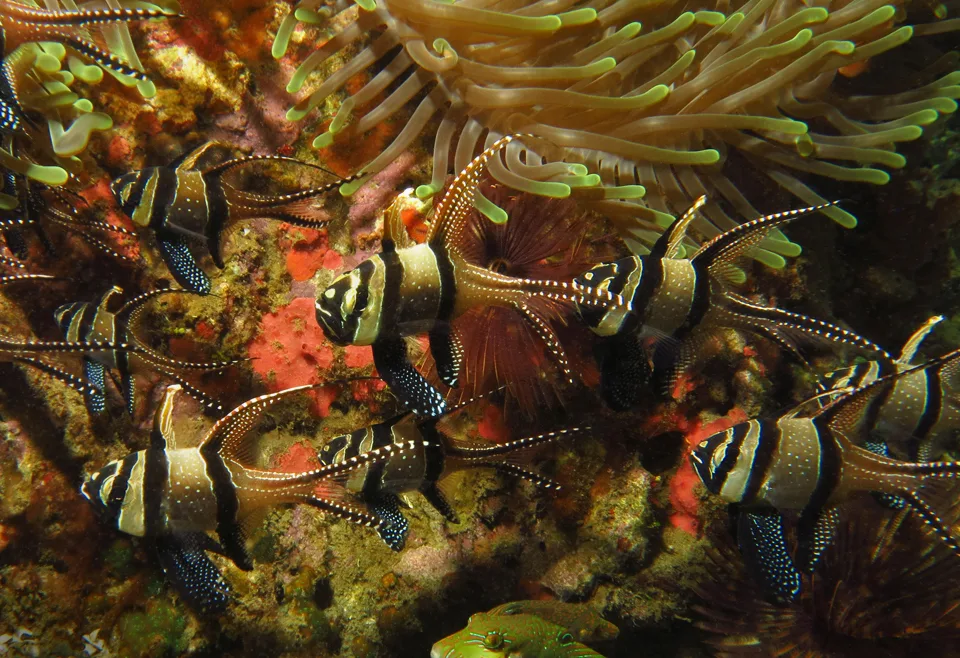
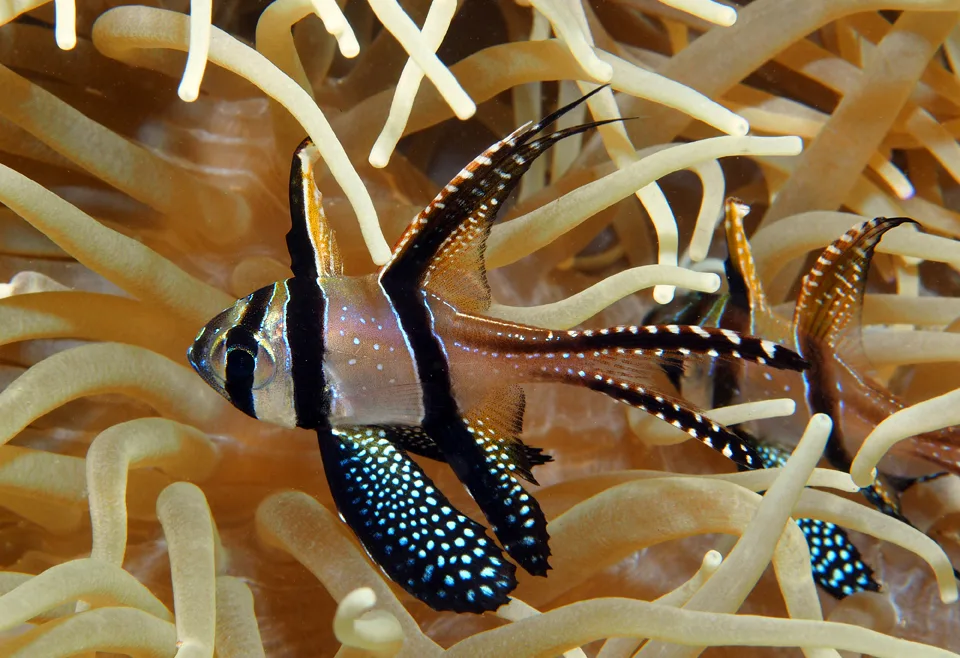
They are small. NOAA gives a maximum length of 3.4 inches (about 8.6 cm), and most you see will be shorter. Look for a silvery body with three bold black bars, long trailing fins, a deeply forked tail and white dots scattered over the fins.
They hover in small groups rather than swim around, and stay within a hand’s length of their shelter: the spines of sea urchins or the tentacles of anemones. When you come close, the group tucks deeper into the spines instead of darting away. That habit makes them easy to watch, and also easy to catch.
Their breeding is unusual too. Males brood the eggs in their mouths and release fully formed juveniles, which settle straight into the same patch of urchins. With no drifting larval stage, a reef that has been emptied of cardinalfish does not refill from somewhere else.
Where to see Banggai cardinalfish in the wild
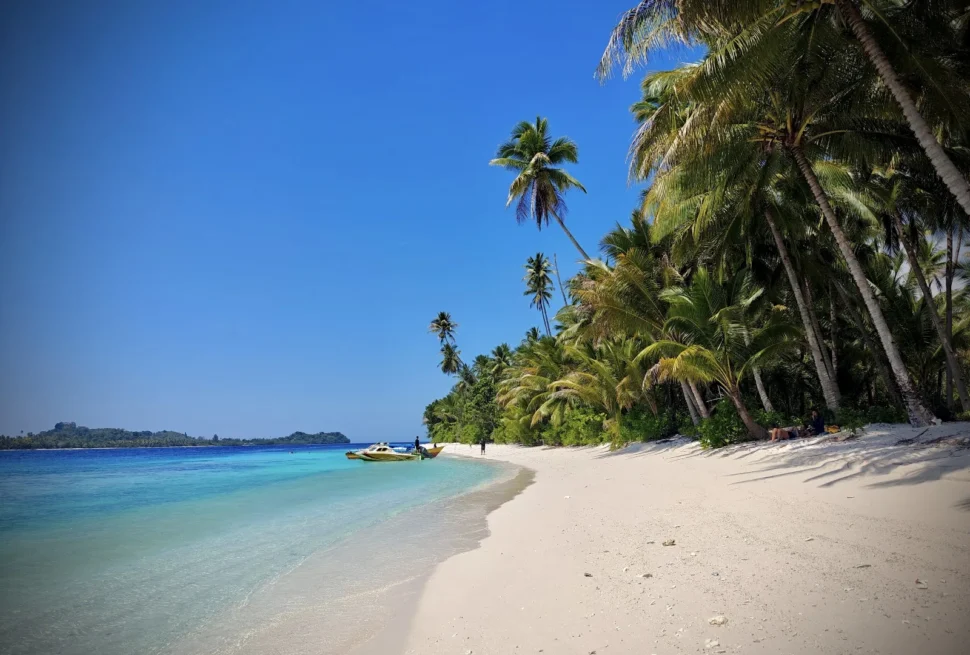
Our usual spot is Bontolan beach on Banggai Laut, about 15 minutes from Banggai town. The fish live in the shallows just off the sand, so you can snorkel straight from the beach without a boat. We take guests there first thing in the morning, while the beach is still quiet.
The water there is very shallow. In a 2019 report from Bone Baru, another Banggai Laut village, Mongabay measured a little over 2 metres over the cardinalfish beds at high tide and about half a metre at low tide. Time your swim for mid to high tide so you float above the urchins instead of wading between them.
Numbers vary a lot from beach to beach. A government survey of eight Banggai Laut sites in October 2019 found declines at most of them, with Mandel at a critical level, while Kombongan and the island of Mbuang-Mbuang had more fish than before. A guide who knows the current state of each beach is worth more than any map.
Bone Baru, in Banggai Utara district about 20 minutes from Banggai town, is also home to BCF Lestari, a village group that breeds the fish with support from Indonesia’s fisheries ministry. If you want to see that side of the story, tell us before you travel and we will check whether a visit can be arranged.
How to get to the Banggai Islands
Every route starts in Luwuk, which has about four Batik Air flights a day from Makassar (around 75 minutes) plus Wings Air from Palu and Manado. From Luwuk there are two ways to reach Banggai Laut:
- The direct ferry from Luwuk to Banggai, usually on Monday, Wednesday and Friday, leaving around 16:00 or 21:00 and taking 8 to 9 hours.
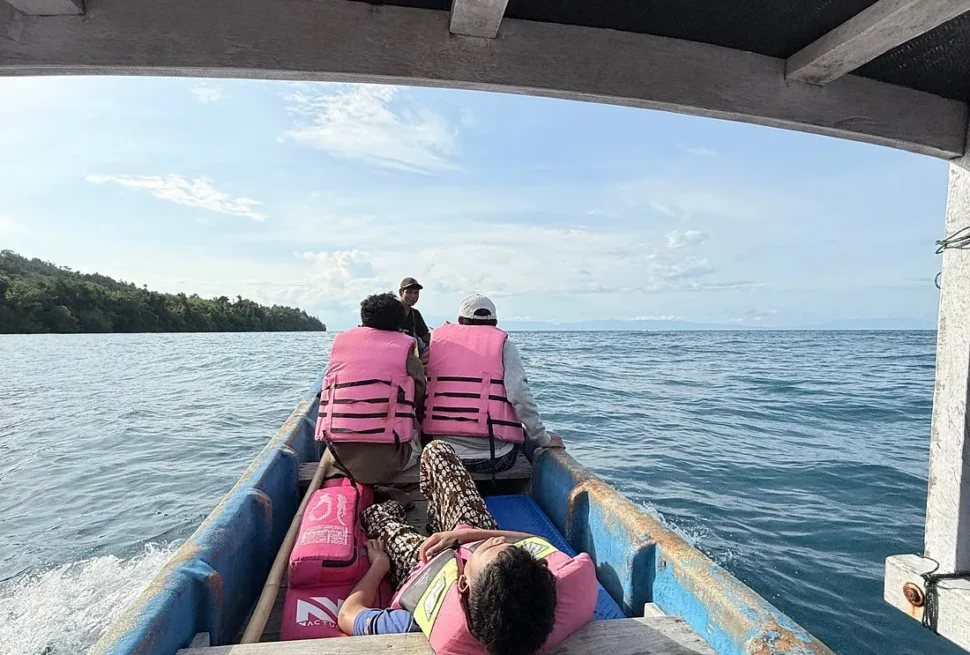
- Via Peleng: a wooden boat to Leme-Leme (about 2 hours, around IDR 55,000 or US$3.30), a drive to Tobing jetty, then a shared speedboat to Banggai (about 30 minutes, around IDR 80,000 or US$5).
Our Banggai Laut travel guide covers boats, places to stay and the best beaches in more detail. The Banggai Islands itinerary shows how a cardinalfish morning fits into a week on the islands.
Banggai Islands Tour: Reefs, Cardinalfish & the Blue Lake
When to go
The fish stay in the same shallow patches all year, so there is no cardinalfish season as such. Calm sea and a good tide matter far more than the month, and the ferry timetable usually decides your dates anyway.
Indonesia protects the species around the Banggai Islands in February and March, and again in October and November. These are the peak spawning months, and catching the fish is banned during them under Ministerial Decree 49/2018. They are also the months when you have the best chance of spotting a male with a mouthful of eggs.
Why are Banggai cardinalfish endangered?
The fish has a tiny range, its populations are split between islands, and its young do not spread far. On top of that, demand from the aquarium trade, much of it from North America, took large numbers from the wild. Mongabay’s 2022 report estimated the whole wild population at no more than about 2.4 million fish.
The urchins and anemones the fish depend on are under pressure as well, and when a patch of urchins disappears, its cardinalfish go with it. The IUCN assessment behind the Endangered listing names collection for the trade and habitat loss as the main threats.
Indonesia responded with the 2018 decree and national action plans for 2017 to 2021 and 2022 to 2026. Proposals to list the species under CITES were made in 2007 and 2016, and both were withdrawn. In the United States it is listed as Threatened under the Endangered Species Act.
How to watch without harming them
- Float, don’t stand. The urchins and anemones are the fish’s only shelter, and one careless fin kick can flatten a patch.
- Keep your hands to yourself: no touching fish, urchins or anemones, and no feeding.
- Don’t chase a group into open water for a photo. Hold still and they drift back to the edge of the spines.
- Don’t buy fish, urchins or anemones from anyone on the beach.
- Wear a rash vest so you need less sunscreen in such shallow water.
For aquarium keepers: captive-bred or wild-caught?
Captive breeding is well established, and village groups in Banggai Laut now farm the fish as well. In 2019 Mongabay reported that BCF Lestari sold four-month-old farmed fish for about IDR 30,000 each, against about IDR 7,500 for a wild-caught one.
When you buy, ask for captive-bred stock and the name of the breeder, because a vague “sustainably sourced” label tells you very little. Never release an aquarium fish into the sea. That is exactly how the introduced populations in Luwuk harbour and Lembeh began.
For biology and habitat, read the NOAA Fisheries species profile. The Wikipedia article on the Banggai cardinalfish covers its discovery and trade history.
If cardinalfish are the reason you are coming, say so when you message us on WhatsApp. We will plan the Bontolan morning around the tide and build the rest of the trip from there, whether that is a few days on Banggai Laut or the full five-day Banggai Islands tour with Paisu Pok lake on Peleng.
Cover photo: a group of Banggai cardinalfish among anemone tentacles in the Lembeh Strait, North Sulawesi, where an introduced population lives. Pauline Walsh Jacobson, CC BY 4.0 (cropped), via Wikimedia Commons.
Naturally, only around the Banggai Islands in Central Sulawesi, Indonesia: Peleng, Banggai Laut and the small islands nearby, across roughly 5,500 km² of sea. Introduced groups also live in Luwuk harbour and the Lembeh Strait in North Sulawesi, descended from aquarium fish. To see them in their native home, go to Banggai Laut.
Their range is tiny, their populations are split between islands and their young do not disperse, so an area that has been emptied does not refill. Heavy collection for the aquarium trade and damage to the sea urchins and anemones they shelter in added to the pressure. The IUCN lists the species as Endangered.
NOAA gives a maximum length of 3.4 inches, about 8.6 cm, and most fish you see on the reef are smaller. They are easy to recognise anyway: a silvery body with three black bars, long trailing fins, a forked tail and white dots, hovering in small groups among urchin spines or anemone tentacles.
Yes. On Banggai Laut they live in very shallow water just off the beach, so no boat or diving is needed. We take guests to Bontolan beach, about 15 minutes from Banggai town, early in the morning and around mid to high tide. Float above the urchins and never touch the fish or their shelter.
Yes, captive breeding is well established, and village groups in Banggai Laut farm them too. Wild-caught fish still enter the trade, so ask the seller for captive-bred stock and the name of the breeder. Never release aquarium fish into the sea, because that is how introduced populations outside the Banggai Islands started.