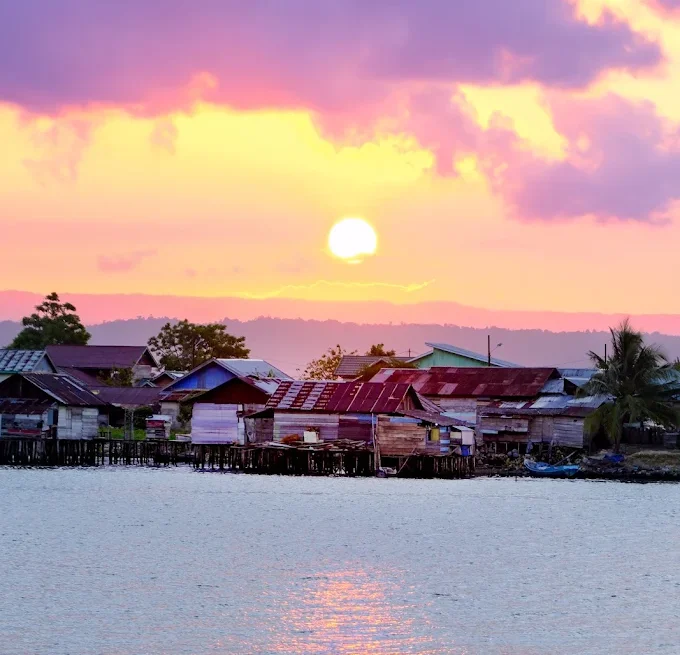
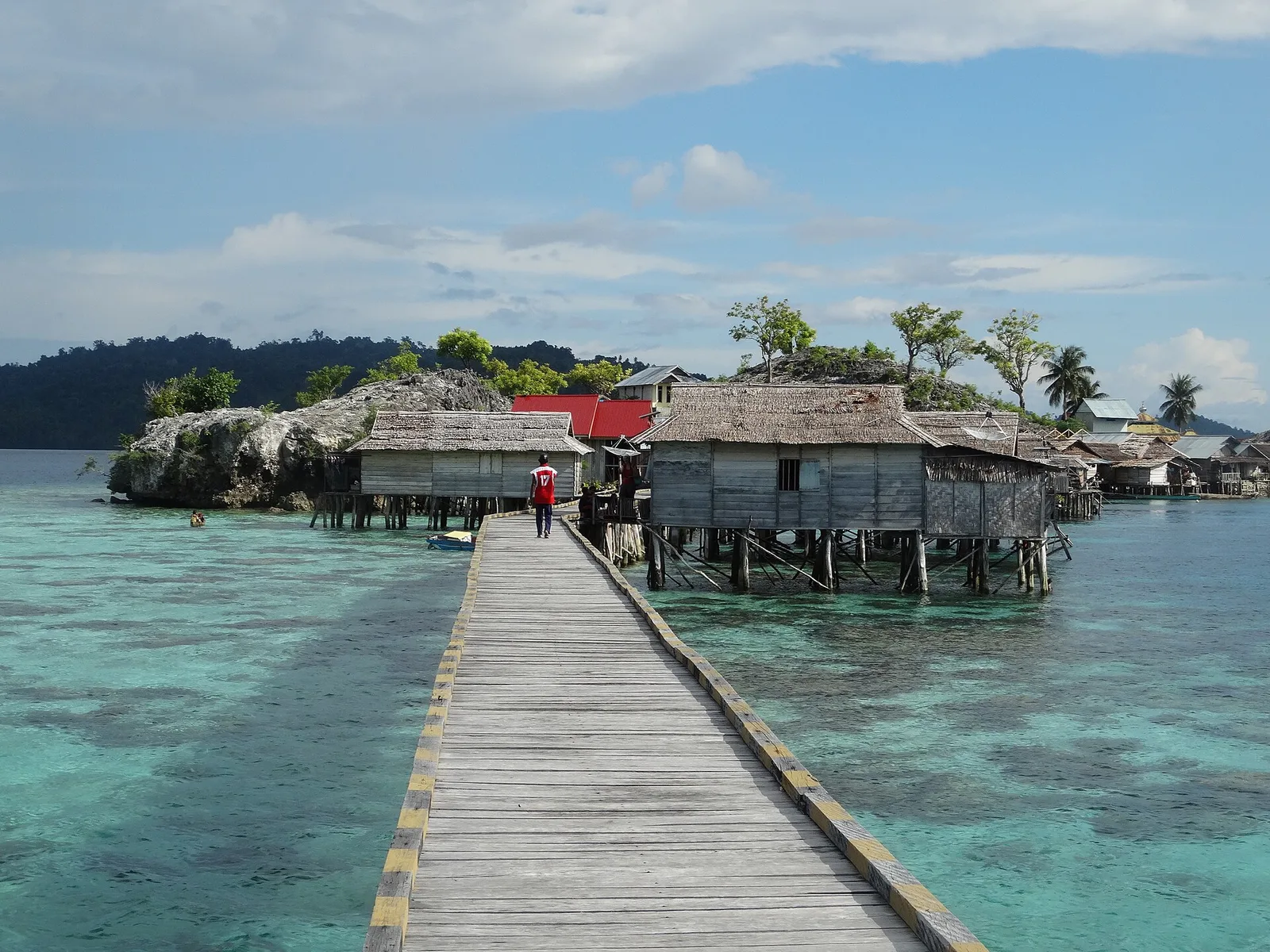
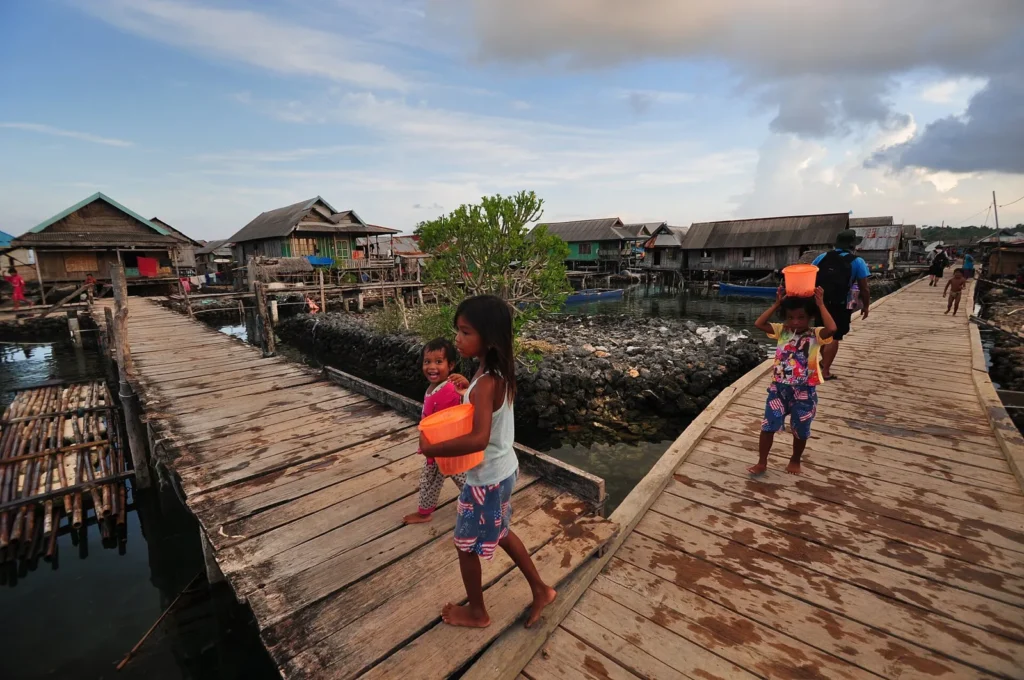
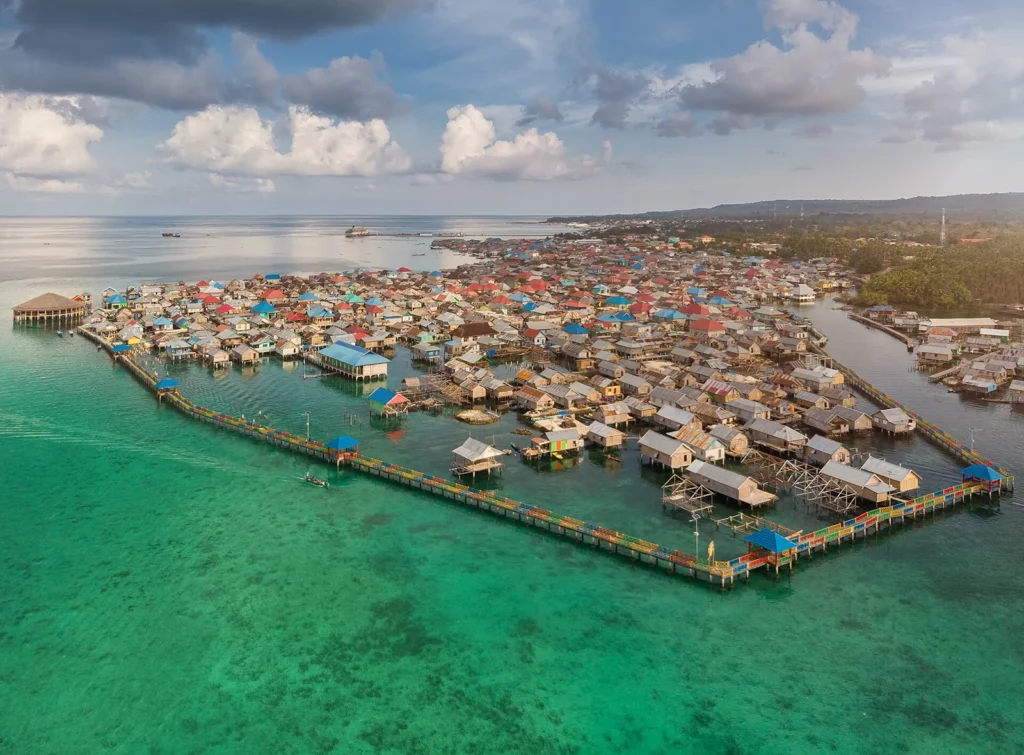
The Bajau people are a sea-going people of about one million, spread along the coasts of Indonesia, Malaysia and the Philippines; in Indonesia they are called the Bajo, and many call themselves Sama. Few still live on boats: most Bajau now live in villages of stilt houses over shallow water, and several of those villages are in Central Sulawesi, around Luwuk and in the Banggai Islands.
The 2018 study that found Bajau divers have unusually large spleens was done in Jaya Bakti, a Bajo village in Banggai Regency, the same regency as Luwuk. Below is what that research actually says, which Bajo villages in Banggai we could confirm in published sources, and how to visit one in a way the village is comfortable with.
Who are the Bajau people?
Bajau is the name used in Malaysia and in most English writing. Bajo is the Indonesian form, and Sama or Sama-Bajau is what linguists and many of the people themselves use. A 2017 genetic study in the European Journal of Human Genetics called them the largest sea nomad group left in the world, and noted that some were still living as nomadic seafarers about 40 years earlier, in other words into the 1970s.
Where they came from is still argued over. Bajo oral traditions point to Johor in Malaysia, to Brunei or to South Sulawesi; language studies point to the Sulu archipelago in the southern Philippines. The 2017 genome study of the Bajo sampled 73 people from Derawan and Kotabaru in Borneo and from Kendari in Southeast Sulawesi. All three groups shared a common link with South Sulawesi, the oldest mixing event the team could date fell in the fourth century CE, and the two Borneo communities formed later, around the 12th and 14th centuries.
Bajau sea nomads today: from boats to stilt villages
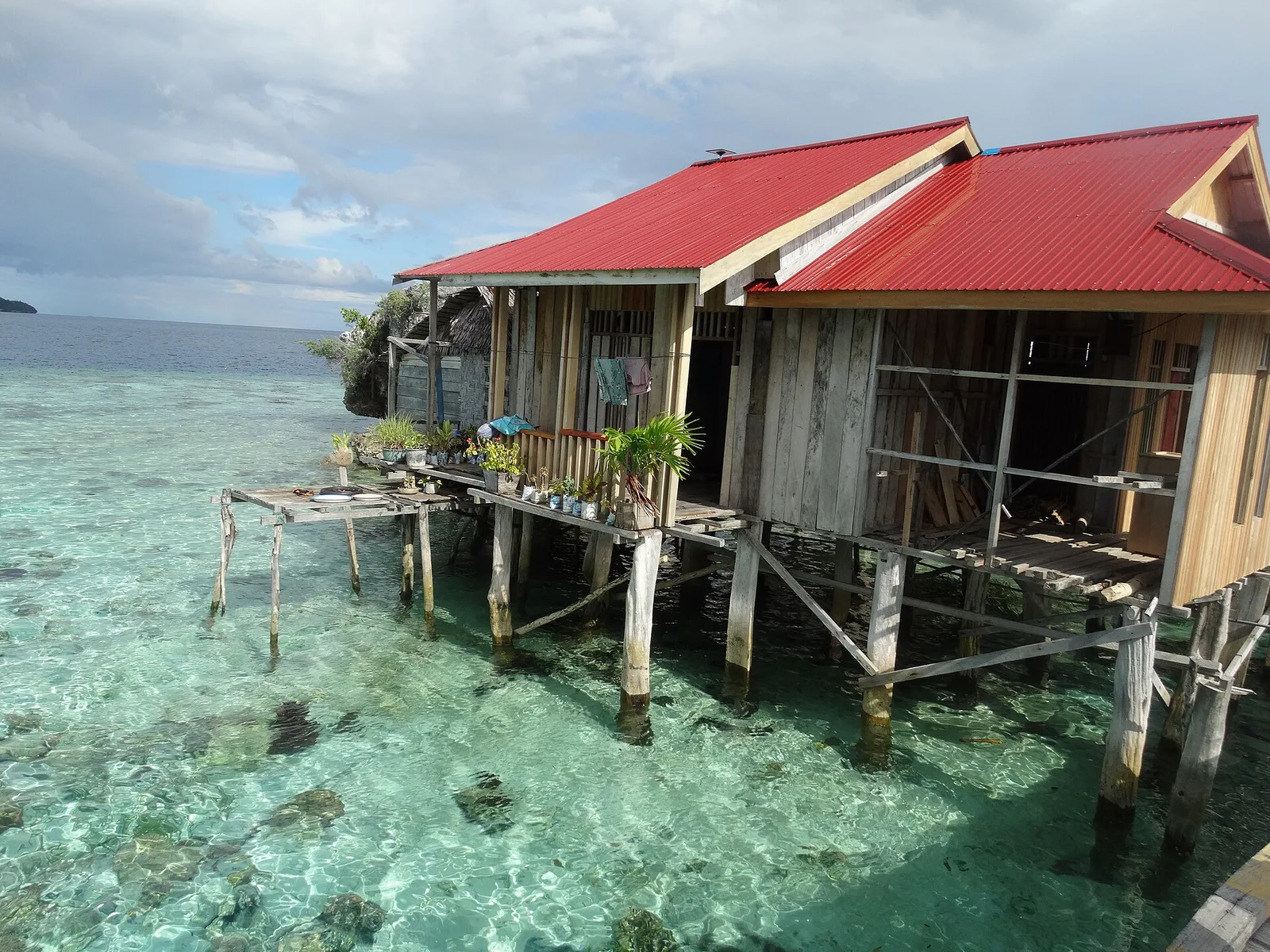
The houseboat years ended within living memory. Torosiaje, a Bajo village in Pohuwato on the Gorontalo side of the Tomini Gulf, shows the usual sequence: the Dutch colonial government registered the settlement as a village in 1901, families kept living on their boats into the 1930s, and the first shelters over the water went up around 1935. Mongabay counted about 245 houses there in 2023, standing roughly 600 m offshore.
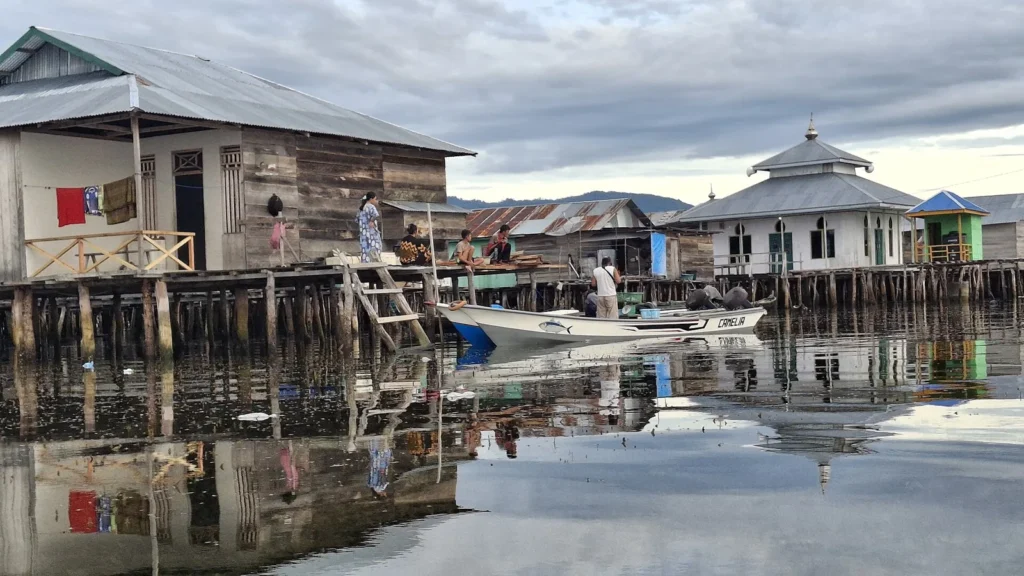
Jaya Bakti, near Luwuk, follows the same pattern. A 2026 study by historians at Universitas Negeri Yogyakarta records Bajo living there since 1825, in houses built over the sea on dead coral, and trading their catch with the neighbouring Saluan farmers for bananas. Most men still fish, and they read fog, wind and rain before deciding whether to go out.
Bajau people and the spleen: what the 2018 study found
The paper is Ilardo and colleagues, Physiological and Genetic Adaptations to Diving in Sea Nomads, published in Cell (volume 173, pages 569 to 580) on 19 April 2018. Melissa Ilardo, then at the University of Copenhagen, worked in Jaya Bakti and compared the Bajo there with the Saluan of Koyoan, a village about 25 km away whose people spend little time in the water.
Ultrasound scans showed Bajau spleens about 50 percent larger than Saluan spleens. The gap held for Bajau who did not dive, which pointed to genes rather than training. The spleen matters because during a breath-hold it contracts and pushes oxygen-carrying red blood cells into the blood, which is why Ilardo compared it to a scuba tank.
In the genomes, the team found signs of natural selection on PDE10A, a gene linked to thyroid hormone levels, which affect spleen size in mice, and on BDKRB2, a gene involved in the diving reflex. They were careful about the limits: the thyroid link has not been shown in humans, and outside scientists said more data is needed before the chain from gene to spleen to longer dives counts as proven.
How long can Bajau people hold their breath?
The Cell paper measured spleens and DNA, not breath-holds. Press coverage at the time repeated a figure of up to 13 minutes for one dive; it comes from accounts, not from timed tests, so treat it as a claim. The measured numbers are about whole working days: researchers who timed Bajau spearfishers in the Philippines in 2009 and 2010 found they spent around 60 percent of their diving time below the surface, more than five hours underwater in a day.
Bajau tribe myths and facts: eyes, eardrums, webbed feet
The famous underwater-vision study is not about the Bajau. Anna Gislén and colleagues at Lund University tested children of the Moken, a different sea nomad people in Thailand, and reported in Current Biology in 2003 that they saw more than twice as sharply underwater as European children (6.06 against 2.95 cycles per degree). They did it by narrowing their pupils to 1.96 mm and focusing at the limit of the human eye, and a 2006 follow-up found European children reached the same level after 11 training sessions.
Bajau children who grow up in the water may well learn the same trick, but nobody has measured it in a Bajau village. When the BBC wrote in January 2011 that Bajau children see unusually well underwater, it was citing the Moken work.
Eardrums are where diving costs something. In that BBC report, the director of the series Human Planet said the Bajau spearfisher his crew filmed had ruptured eardrums and poor hearing because he never equalised the pressure in his ears. We found no reliable source showing that Bajau children have their eardrums punctured on purpose, although the claim is repeated widely online.
On depth, a Cell Press photo caption released with the 2018 study says Bajau divers reach about 70 m with only weights and wooden goggles, while the BBC described ordinary fishing dives of around 20 m. Webbed feet or hands appear in no study we could find; the larger spleen is the only physical difference that has actually been measured.
What religion are the Bajau people?
Most Bajau are Muslim, and researchers writing in Kawistara, a Gadjah Mada University journal, trace that Islamic identity through a Bajo manuscript, the Lontarak Assalenna Bajo. Many families also keep older beliefs about rulers of the sea, called Mbo Ma Dilao, with spoken formulas and small offerings before fishing. For a visitor that means Friday midday prayers, the Ramadan fast and modest dress all apply in a Bajo village.
Bajau in Sulawesi: the Bajo villages of Banggai
Mongabay describes Bajo communities spread from the Tomini Gulf through the waters of Banggai to Wakatobi. These are the Banggai villages we could confirm in published sources. The list is not complete, and local people will name others; we would rather leave a village out than guess one.
| Village | Where | What the sources say |
| Jaya Bakti | Pagimana district, Banggai Regency, on the mainland north of Luwuk | Bajo since 1825; site of the 2018 spleen study; six dancers perform the Putri Papu dance for honoured guests |
| Kalumbatan | Totikum Selatan district, south coast of Peleng, Banggai Kepulauan | At least 119 octopus fishers; resettled on former coconut land after the 2000 earthquake and tsunami |
| Tinakin Laut | Banggai district, Banggai Laut | Mostly Bajo fishing families; 2,086 people in 579 households in a 2024 study |
| Monsongan | Banggai Selatan district, Banggai Laut | Bajo since the early 1940s; known for babangi, fishing trips of up to 15 days |
| Bajo | Liang district, Peleng, Banggai Kepulauan | A village with this name on the 2024 election lists; we found no published profile |
Jaya Bakti is in Pagimana, where the ferry from Gorontalo docks; the overnight crossing on our six-day Luwuk and Gorontalo trip lands there. The Putri Papu dance the village performs for guests retells a legend about a Bajo princess married to a son of the king of Bone.
Kalumbatan is on the south coast of Peleng, the largest Banggai island, at one of the two jetties for the short crossing to Banggai Laut. In July 2024 Mongabay reported speedboats from the Banggai Laut side taking about 20 minutes for IDR 70,000 (about USD 4). The fishers there catch octopus with a crab-shaped lure called cipo, which carries nine hooks, and were paid IDR 45,000 a kilo for grade A octopus, against a past high of IDR 85,000.
Peleng’s capital, Salakan, has an older Bajo quarter too. A historian at Tadulako University counted six Bajo from the Salakan settlement who finished senior high school between 1930 and 1975, and 104 between 1976 and 2000.
On Banggai Laut, Tinakin Laut is in Banggai district, the same district as Banggai town, where most visitors sleep; our Banggai Laut travel guide covers the town and its boats. Further south, men from Monsongan still go out in groups of five or six boats for up to 15 days, sleeping in shelters on atolls called babaroh, while their wives at home keep rules such as not throwing out kitchen ash until the boats are back.
How a Bajau village fits into a Banggai trip
You do not need a separate trip. The three easiest villages sit on routes people already travel: Kalumbatan on the Peleng to Banggai Laut crossing, Tinakin Laut from a base in Banggai town, and Jaya Bakti on the road to or from Pagimana. Our day-by-day Banggai Islands itinerary already crosses between Peleng and Banggai Laut, so a stop on the Kalumbatan side adds a few hours rather than a day.
Plan it with someone the village knows. Your boatman, your homestay owner in Banggai town or our own team can ask the village head (kepala desa) whether a visit suits that day, because weddings, funerals and Ramadan all change the answer.
Banggai Islands Tour: Reefs, Cardinalfish & the Blue Lake
Visiting a Bajau village respectfully
A Bajo village is a neighbourhood, not a sight.
- Arrive with an introduction. Ask your boatman or host to take you to the village head or an elder first; two minutes of introductions changes how the rest of the visit goes.
- Ask before every photo and accept a no. Ask a parent before photographing children, never photograph inside a house uninvited, and do not fly a drone over homes without the village’s agreement.
- Do not hand out money or sweets to children. It teaches them to ask every boat that arrives. If you want to give something, give school supplies through the village head or the school, or buy fish or octopus at the price asked.
- Dress as you would in any Muslim town: shoulders and knees covered, and a sarong over swimwear once you step off the boat. Avoid Friday midday, when the men are at prayer.
- Walk the plank walkways slowly and one at a time. Fish and octopus drying on racks are someone’s income, so do not touch them.
- Do not buy turtle shell or Banggai cardinalfish. Every sea turtle species is protected under Indonesian law, and the cardinalfish is listed as endangered.
If you want a Bajo village on your route, say so when you plan the 5-day Banggai Islands tour, and we will check which village fits that week’s boats.
The Bajau are a maritime people of about one million living along the coasts of Indonesia, Malaysia and the Philippines. Indonesians call them Bajo, and many call themselves Sama. Until roughly the 1970s some families still lived full time on boats; today most live in stilt villages and work as fishers, traders or civil servants.
In scattered coastal villages from the southern Philippines and Sabah in Malaysia to eastern Indonesia. In Sulawesi there are Bajo villages in the Tomini Gulf, Wakatobi and Kendari, and in Banggai: Jaya Bakti near Pagimana, Kalumbatan on Peleng, and Tinakin Laut and Monsongan on Banggai Laut, among others.
The 2018 spleen study did not time breath-holds, and figures of up to 13 minutes come from accounts in the press, not tests. What researchers measured in the Philippines is endurance: spearfishers spent about 60 percent of their diving time underwater, more than five hours a day, in many short dives.
A 2018 study in Cell, carried out in Jaya Bakti in Central Sulawesi, found Bajau spleens about 50 percent larger than those of nearby Saluan farmers, even in Bajau who do not dive. The authors linked this to natural selection on the PDE10A gene, though the full mechanism in humans is unproven.
Not proven for the Bajau specifically. The well-known study tested Moken children in Thailand (Gislén and colleagues, Current Biology, 2003), who saw underwater more than twice as sharply as European children by narrowing their pupils and straining their focus. European children matched them after training, so it is a learned skill that young Bajau divers may share.
Yes, as a guest rather than on a tour. In Banggai, Kalumbatan sits at a jetty on the Peleng to Banggai Laut crossing and Tinakin Laut is in the same district as Banggai town. Go with a local introduction, ask the village head first, and ask before taking photographs.